
Health philosophy
“Let food be thy medicine and medicine be thy food!” -Hippokrates von Kos, ca. 400 v. Chr.
Like Hippocrates of Kos, we share the opinion that nutrition plays a crucial role in our health. Key cornerstones in our health philosophy are as follows:
- Keep your diet as natural as possible.
- There are – apart from industrial trans fats – no good or bad fats, only unfavorable ratios.
- Sugar, white flour and an excess of omega-6 fatty acids is a main cause of many health problems.
- Daily intake of a natural fish oil or vegetable algae oil high in omega-3 fatty acids is beneficial to our health.
What does NORSAN stand for?
NORSAN’s mission is twofold:
- To educate people about how fats work, especially the role of omega-3 fatty acids for our health.
- To develop and provide the best omega-3 products. Read here about our product philosophy.
The effect of omega-3 fatty acids
The actual effect of omega-3 fatty acids is always discussed in many different ways. In expert circles, for example, certain groups are of the opinion that the regular intake of omega-3 has no effect and is therefore not necessary for health. On the other hand, there are a number of experts who can clearly prove the positive health effects of omega-3 for a variety of different diseases and health problems.
So does omega-3 help or not?
The answer is simple: omega-3 fatty acids don’t help if you don’t use them properly. Compare it to exercise, which most people see as a positive factor in one’s health. However, if someone jogs for 3 minutes every day or does a push-up every day, it is very likely that these actions will not significantly improve health. The situation is similar with omega-3.
As with all foods, one must additionally pay attention to quality. What raw materials were used and how are these raw materials processed? In extreme cases, if you take 10 capsules where the fish oil is already spoiled, then you cannot expect a good effect. The body tries (fortunately) to get rid of this oil and you have an unpleasant belching. With a good quality omega-3 oil you do not have this. For this reason, in the first years NORSAN offered our oils only in liquid form. Not because we think that capsules are not useful and good in certain cases – rather we wanted to emphasize that you don’t have to “hide” it in a capsule. We would never think of such an idea with other foods.There are many omega-3 concentrates on the market. The advantage of concentrates is that you have to take fewer capsules. However, the night disadvantage is that it is no longer a natural product. NORSAN believes in keeping food as natural as possible. Consequently, you will not find omega-3 concentrates in any of our products, only naturally high-dose oils.What should be the dosage of omega-3?
The answer to this question is different for each person and results from the diagnostic method described above. Consequently, the level of dosage depends on the individual fatty acid ratio in the body and should be high enough to compensate for a potential deficit. Regarding the optimal omega-3 content in the body, there is a broad scientific consensus that it should be above 8%.For this reason, NORSAN takes the position that a sufficiently high dosage is necessary to achieve a desired health effect.
In cooperation with the leading laboratory in Europe for fatty acid measurements, Omegametrix® GmbH in Munich, NORSAN has now carried out more than 30,000 individual fatty acid analyses. The results are quite clear: for adults with an existing omega-3 deficit, the effective dosage starts at 2,000 mg of omega-3 fatty acids (EPA and DHA) per day. On the other hand, what effect occurs when taking 1-2 conventional omega-3 capsules with an omega-3 content of approx. 150 mg each? The clear answer is: none! This is also the explanation for why studies keep turning up in which the intake of omega-3 showed no effect – the chosen dosage was too low.Diagnostic Method – The Measurement of Success Instead of Just Hoping
What is omega-3 fatty acids all about? From our point of view, the focus is not on which capsules or which oil to take, but on ensuring that there are enough omega-3 fatty acids in the body. The first diagnostic step is therefore to measure the fatty acids in the body. Their ratio can be determined in a fatty acid analysis.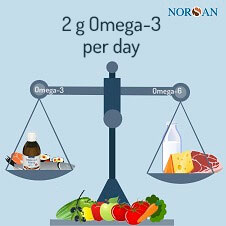
- Omega-6/3 ratio between 1:1 and 2.5:1
- Omega-3 index above 8
- Industrial trans-fat content below 0.5 %
The structure of fatty acids in the body is a reflection of our diet
The following can be a suggestion for regulation – depending on the individual measurement result:
- Too high omega-6 arachidonic acid -> Less consumption of meat products.
- Too low omega-3 fatty acids -> Higher consumption of fish products
- Too high trans fatty acids -> Less consumption of industrially processed foods with trans fatty acids (“hydrogenated vegetable oils”)